Introduction
An industrial boiler is a pressure vessel that runs your plant for 20 years or more. When it performs well, nobody notices. When it doesn’t, production stops.
That is why the choice between boiler manufacturers in India should not come down to the quotation alone. Two boilers with the same capacity, pressure and fuel can look identical on a datasheet and still behave very differently after three years of operation. The difference usually lies in how they were designed, welded, tested and assembled.
This guide explains which manufacturing factors actually affect boiler safety, efficiency and service life, and how plant heads and purchase teams can check them before placing an order.
The Problem: Same Specification, Different Outcomes
Most boiler enquiries in India are compared on a few headline numbers: capacity (TPH), working pressure, fuel type and price. These numbers matter, but they only describe what the boiler is supposed to do. They say nothing about how well it will do it over time.
Quality gaps usually show up after commissioning:
- Repeated tube leaks from poor weld penetration or incorrect tube expansion.
- Efficiency falling below design because of poor insulation, air leakage or insufficient heat transfer area.
- Refractory failure in solid-fuel boilers due to low-grade material or poor installation.
- Unplanned shutdowns that cost far more in lost production than the original price difference.
- Safety risks, since a boiler stores a large amount of energy under pressure.
A lower initial price can quickly turn into a higher total cost of ownership.
What Manufacturing Quality Actually Means in a Boiler
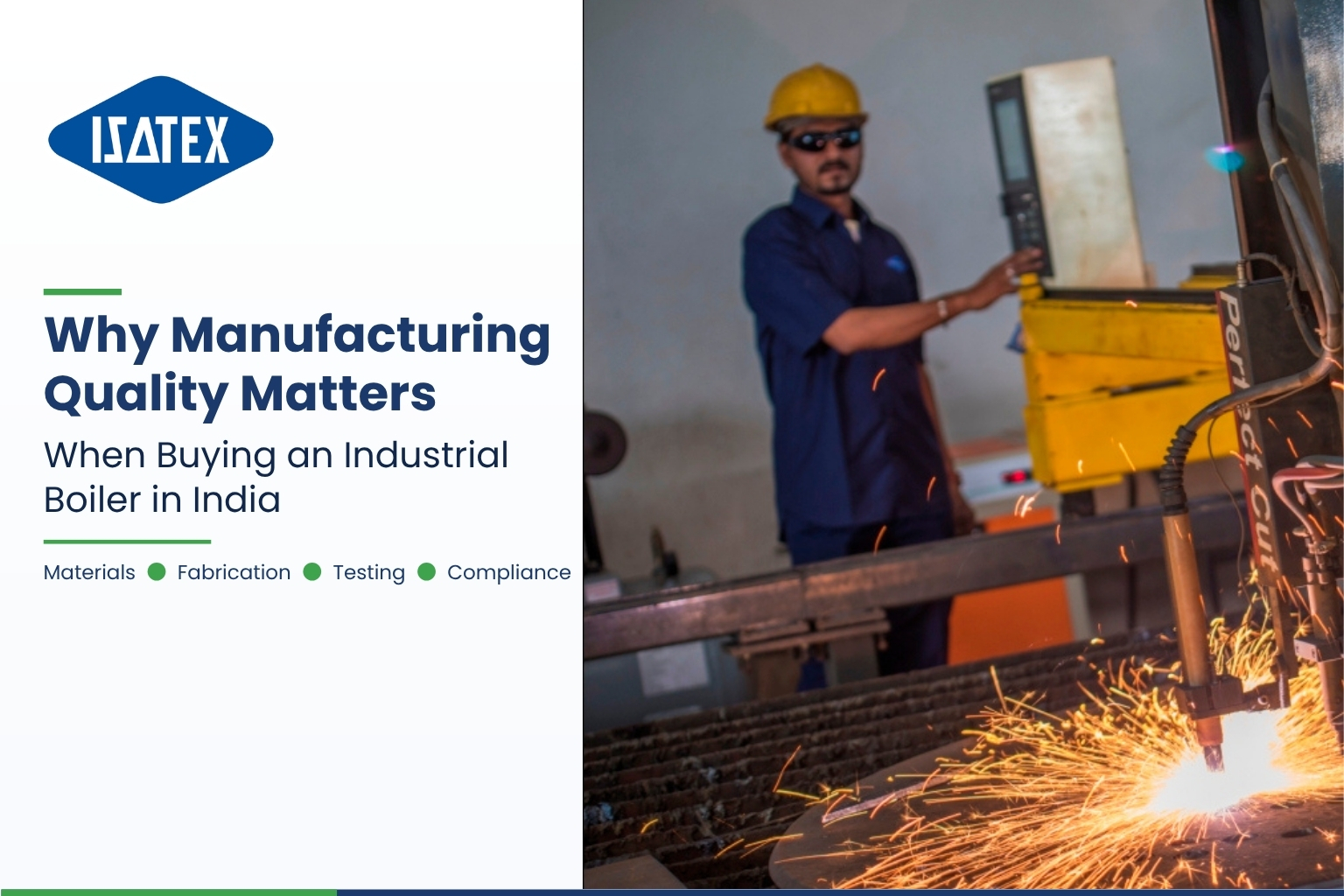
When experienced buyers talk about quality, they mean specific, checkable things. Here is what a reliable boiler manufacturing company in India should be able to demonstrate.
1. Sound Thermal and Pressure-Part Design
Quality starts before fabrication. The boiler must be designed with:
- Correct heat transfer area for the rated capacity and fuel.
- Adequate furnace volume for complete combustion, especially for biomass, coal and other solid fuels.
- Pressure-part thickness calculated as per the applicable code (IBR for Indian installations; ASME, BS or other codes for export, as specified).
- Allowance for your actual fuel quality, not just an ideal design fuel.
An undersized furnace or insufficient heating surface may pass the initial trial but will struggle at full load and with varying fuel quality.
2. Certified Raw Materials with Full Traceability
Pressure parts such as shells, tubes, headers and drums must use materials approved under the applicable code. Commonly used grades include boiler-quality plates such as SA 516 Gr. 70 and seamless tubes such as SA 106 Gr. B / SA 210 Gr. A1 [VERIFY grades applicable to each ISOTEX product line].
What matters for the buyer:
- Mill test certificates for all pressure-part materials.
- Traceability from raw material to the finished component.
- No substitution with lower-grade material without documented approval.
3. Welding Quality and Qualified Welders
Many boiler failures that are not caused by operation can be traced back to welds. Good manufacturers control welding through:
- Approved Welding Procedure Specifications (WPS) and Procedure Qualification Records (PQR).
- Certified welders for pressure-part welding [VERIFY exact certification wording under current regulations].
- Controlled welding consumables, stored and used correctly.
- Post-weld heat treatment wherever the code requires it.
4. Non-Destructive Testing (NDT)
Welds should not be accepted on visual inspection alone. Typical checks include:
- Radiography of critical seams.
- Ultrasonic testing where applicable.
- Dye penetrant or magnetic particle testing for surface defects.
The extent of NDT depends on the code and design, but a serious manufacturer will share the NDT plan and reports with you.
5. Hydraulic Testing and Statutory Inspection
Every pressure part must be hydraulically tested above its working pressure before dispatch, and witnessed by the competent inspecting authority. The test pressure is commonly 1.5 times the maximum working pressure [VERIFY against current Indian Boiler Regulations].
In India, boilers are governed by the Boilers Act, 2025, which replaced the Boilers Act, 1923 and came into force on 1 May 2025. Registration and inspection continue under the Indian Boiler Regulations until new regulations are notified. Buyers should confirm that the manufacturer will provide every document needed for registration at the site.
6. Fit-Up, Assembly and Finishing Quality
Details that are easy to overlook often decide real-world performance:
- Proper tube-to-tubeplate expansion or welding.
- Tight casings and doors to reduce air ingress.
- Good-quality insulation and cladding to reduce radiation losses.
- Correctly installed refractory for solid-fuel furnaces.
7. Controls, Safety Devices and Auxiliaries
A boiler is only as safe as its protection system. Check for reliable:
- Safety valves sized for the boiler’s capacity.
- Water level controls and low-water cut-off.
- Pressure switches and interlocks.
- Burner or combustion controls suited to the fuel.
- Matched auxiliaries such as feed pumps, fans, economisers and water treatment.
How Manufacturing Quality Affects Your Business
Quality Factor | What Goes Wrong If Ignored | Business Impact |
Thermal design | Boiler cannot hold rated output | Production bottlenecks |
Material quality | Early corrosion or tube failure | Repair costs and downtime |
Welding and NDT | Leaks at seams and joints | Safety risk and shutdowns |
Hydraulic testing | Undetected pressure-part defects | Inspection rejection, safety hazard |
Insulation and casing | Higher heat loss, air leakage | Higher fuel bill every day |
Controls and safety devices | Unsafe operation, nuisance trips | Accidents and compliance issues |
Documentation | Delays in registration | Delayed plant start-up |
The pattern is clear: most quality shortcuts save money once, at the time of purchase, and cost money every month after that.
Illustrative Scenario: The True Cost of a Cheaper Boiler
This is an illustrative example, not a customer case study.
A mid-sized plant compares two quotations for a solid-fuel steam boiler of the same capacity. Option B is noticeably cheaper, and on paper both meet the requirement.
In practice, Option B uses a smaller furnace and lighter insulation. Within the first year, the plant sees higher fuel consumption for the same steam output and a few tube leaks that force unplanned shutdowns. Each shutdown means lost production, maintenance labour and restart fuel.
Over a 15–20 year life, the extra fuel alone can exceed the original price difference. Add downtime, and the cheaper boiler becomes the more expensive one.
Checklist: How to Evaluate Boiler Manufacturers in India
Use this checklist when shortlisting a boiler company in India:
- Does the manufacturer have in-house design and fabrication, or is work outsourced?
- Can you visit the factory and see ongoing fabrication?
- Will they share a Quality Assurance Plan (QAP) for your order?
- Are material test certificates provided for pressure parts?
- Are welders certified, and are WPS/PQR records maintained?
- What NDT is carried out, and will the reports be shared?
- Is hydraulic testing witnessed by the inspecting authority?
- Does the company have experience with your fuel and your industry?
- Can they share references from plants similar to yours?
- What after-sales support is offered: service engineers, spares availability, response time?
- Is third-party inspection available if your project requires it?
A manufacturer confident in its quality will answer these questions openly.
Where ISOTEX Global Fits In
ISOTEX Global has been designing and manufacturing industrial boilers and thermal heating systems for 50 years, with 10,000 installations across industries in India and export markets. Manufacturing is carried out across four plants in Ahmedabad and Dahej, Gujarat, with the Dahej plant holding ASME certification. Depending on project requirements, equipment can be inspected by third-party agencies such as Lloyd’s Register, Bureau Veritas, SGS and TÜV.
For buyers, this means a single team responsible for design, fabrication, testing and support across steam boilers, thermic fluid heaters, hot water generators and waste heat recovery systems.
[Explore Our Industrial Boiler Solutions](https://isotexglobal.com/)
Key Takeaways
- Capacity, pressure and price alone are not enough to compare boiler manufacturers.
- Design, materials, welding, NDT and hydraulic testing decide long-term safety and performance.
- Poor build quality shows up as higher fuel bills, leaks and downtime.
- Ask for the QAP, material certificates and test reports before ordering.
- Evaluate total cost of ownership over 15–20 years, not just purchase price.
Conclusion
Choosing among boiler manufacturers in India is a long-term engineering decision, not a one-time purchase. The boiler you select will affect your fuel costs, uptime and plant safety every day for decades.
Ask the right questions, verify the manufacturing process, and compare total cost of ownership rather than the quotation alone. That is how you get a boiler that simply works, year after year.
Frequently Asked Questions
1. How do I choose the right boiler manufacturer in India?
Look beyond price. Check design capability, in-house fabrication, material traceability, welding and NDT practices, statutory inspection, fuel experience, and after-sales support. A factory visit is one of the most reliable ways to assess quality.
2. Is IBR approval mandatory for industrial boilers in India?
Boilers that fall within the scope of the Boilers Act, 2025, must be manufactured, inspected and registered as per the applicable regulations. Coverage depends on factors such as volume and pressure [VERIFY current applicability limits]. Your manufacturer should confirm applicability for the specific model.
3. What documents should a boiler manufacturer provide?
Typically: design calculations, material test certificates, NDT reports, hydraulic test certificates, statutory inspection documents for registration, operation and maintenance manuals, and warranty terms.
4. Why do cheaper boilers often cost more over time?
Savings are often made on furnace size, material grade, insulation or controls. These shortcuts increase fuel consumption, maintenance and downtime over the life of the boiler.
5. How long does an industrial boiler last?
A well-built and well-maintained industrial boiler can serve for 20 years or more. Actual life depends on design quality, water treatment, fuel, operating practice and maintenance.
6. Should I visit the manufacturer’s factory before ordering?
Yes, especially for larger or customised boilers. A factory visit lets you see fabrication practices, testing facilities and quality systems first-hand.
7. Can Indian boiler manufacturers build to international codes for export?
Many can. Check whether the manufacturer has experience with the code required in your country, such as ASME, and whether third-party inspection is available.