Introduction
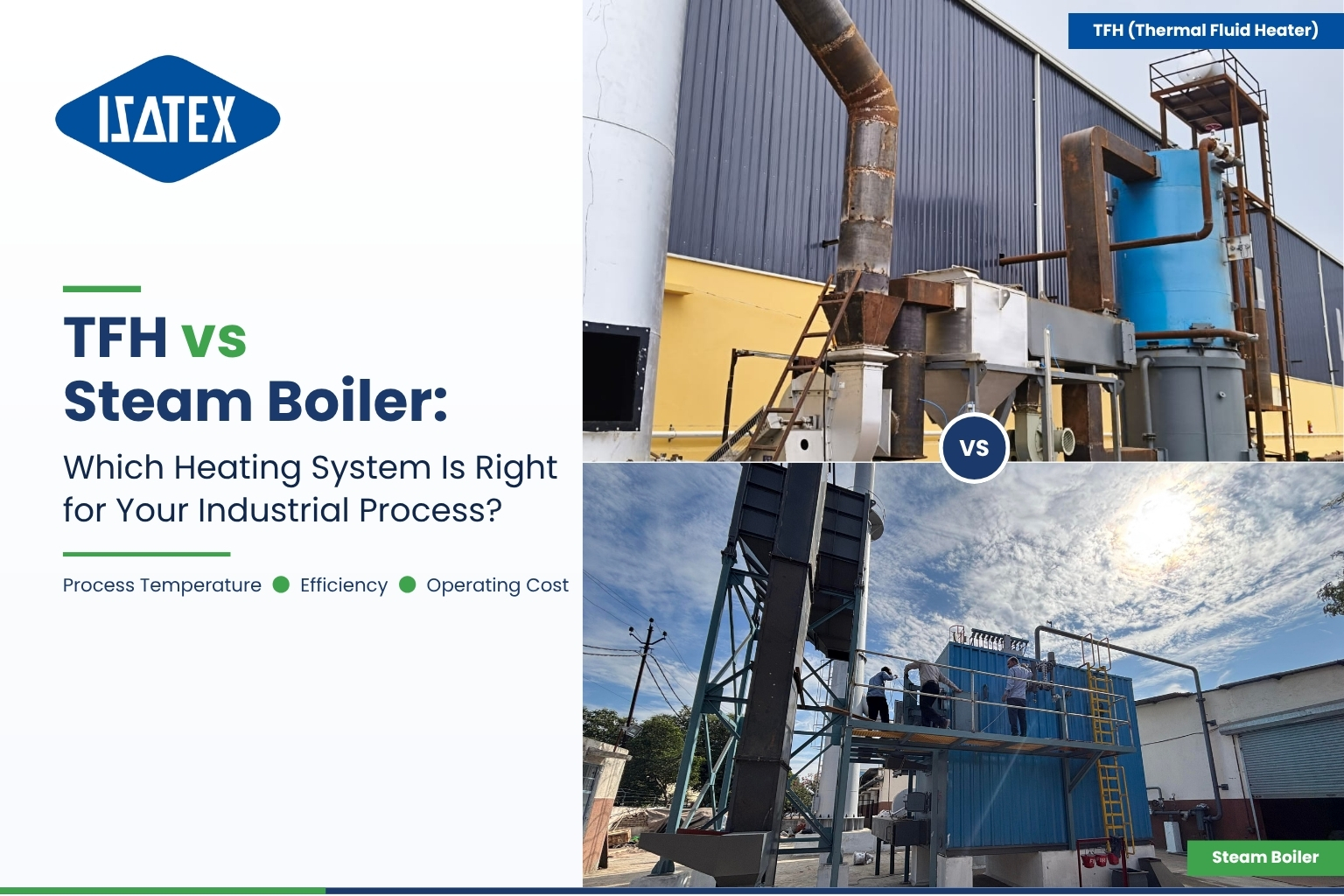
Every process heating project eventually faces the same question: should the plant use steam or a thermic fluid heater?
Both are proven technologies. Both can heat reactors, presses, dryers and vessels reliably. But they work on different principles, and choosing the wrong one can mean higher operating pressure than necessary, higher fuel bills, extra compliance work or a system that simply cannot reach the temperature your process needs.
This guide compares thermic fluid heater vs steam boiler systems on the factors that matter to plant heads and project engineers: temperature, pressure, efficiency, safety, compliance, maintenance and cost, so you can choose the right industrial heating system for your process.
How Each System Works
Steam Boiler
A steam boiler heats water until it turns into steam. The steam travels to the process, gives up its latent heat as it condenses, and the condensate returns to the boiler. Because steam temperature is linked to pressure, higher process temperatures require higher boiler pressure.
Thermic Fluid Heater
A thermic fluid heater (also called a thermal oil heater or hot oil system) heats a special heat transfer fluid and circulates it through the process in a closed loop using a pump. The fluid stays in liquid form and transfers heat as sensible heat, then returns to the heater to be reheated. An expansion tank accommodates the change in fluid volume as it heats up.
The key difference: a thermic fluid heater can deliver high temperatures at low operating pressure, while steam needs high pressure to reach high temperature.
The Temperature–Pressure Question
This is usually the deciding factor. Look at the pressure steam needs to reach typical process temperatures:
Process Temperature Needed | Approx. Steam Pressure Required | Thermic Fluid System Pressure |
150°C | About 4 bar(g) | Low; circulation pressure only |
200°C | About 14.5 bar(g) | Low; circulation pressure only |
250°C | About 39 bar(g) | Low; circulation pressure only |
300°C | About 85 bar(g) | Low; circulation pressure only (fluid grade permitting) |
Up to about 180°C, steam is practical and widely used. Beyond about 200°C, the pressure needed for steam rises sharply, making the boiler, piping and fittings heavier, costlier and more demanding to operate. That is where thermic fluid heaters become the logical choice.
Thermic fluids have maximum operating temperature limits that depend on the fluid grade. Mineral oil based fluids are commonly used up to around 300°C, and synthetic fluids can operate higher.
Thermic Fluid Heater vs Steam Boiler: Side-by-Side Comparison
Factor | Steam Boiler | Thermic Fluid Heater |
Heat transfer medium | Water / steam | Thermic fluid (thermal oil) |
Heat transfer mode | Latent heat on condensation | Sensible heat of circulating liquid |
Temperature range | Best up to about 180–200°C | Commonly up to about 300°C or more, depending on fluid |
Operating pressure | Rises with temperature | Low; independent of temperature |
Boiler regulations | Steam boilers under the Boilers Act 2025 and applicable regulations | Generally not regulated as a steam boiler [VERIFY applicability] |
Water treatment | Required; blowdown and chemical dosing | Not required |
Corrosion / scaling risk | Corrosion and scaling possible if water treatment is poor | No water-side corrosion or scaling |
Temperature control | Controlled by pressure | Precise control of fluid temperature |
Heat transfer rate at user | High (condensing steam) | Lower; may need larger heat transfer area |
Direct use in process | Possible (direct steam injection, humidification) | Not possible; indirect heating only |
Key maintenance | Water treatment, blowdown, traps, condensate system | Fluid analysis, filters, pump seals, expansion tank |
Fire safety consideration | Low (water medium) | Fluid is combustible; leak and fire safety design essential |
Advantages of a Thermic Fluid Heater
- High temperature at low pressure, which reduces pressure-related risks and pressure-part costs.
- No water treatment, blowdown or condensate losses, which removes several ongoing operating costs.
- Precise temperature control, useful for processes that need uniform heating.
- Closed-loop system with minimal heat loss through venting or flash steam.
- Suitable for multiple users at different temperatures through secondary loops.
- Lower compliance burden where the heater does not fall under steam boiler regulations.
Advantages of a Steam Boiler
- Very high heat transfer rate during condensation, so heat exchangers can be smaller.
- Uniform temperature at the heating surface, controlled simply by pressure.
- Direct steam use for cooking, sterilisation, humidification and cleaning.
- Water is non-flammable, non-toxic and inexpensive as a heat transfer medium.
- Well understood by operators and maintenance teams across industries.
Limitations to Consider
Thermic Fluid Heater
- The fluid degrades over time and must be tested periodically and topped up or replaced.
- Thermic fluid is combustible, so leak prevention, proper insulation and fire safety are essential.
- Heat transfer coefficients are lower than condensing steam, so user equipment may need more surface area.
- Cannot be used where the process needs direct steam.
Steam Boiler
- High temperatures demand high pressure and heavier construction.
- Water treatment, blowdown and steam trap maintenance are ongoing tasks.
- Condensate and flash steam losses reduce overall system efficiency if not recovered.
- Statutory registration and periodic inspection apply.
Which Industries Use Which System?
Typically Thermic Fluid Heater | Typically Steam Boiler |
Textile processing (stenters, thermosol, curing) | Food processing and dairy |
Plywood and laminate hot presses | Pharmaceutical processes and sterilisation |
Edible oil refining (deodorisation) | Beverages and breweries |
Chemical reactors needing 200°C+ | Paper machines and corrugation |
Printing and packaging (lamination, rotogravure drying) | Rubber vulcanising (autoclaves) |
Asphalt, bitumen and resins | Distilleries |
Plastics and PU processing | Hospitals and laundries |
Many plants use both: a thermic fluid heater for high-temperature processes and a steam boiler for general process heating, cleaning and humidification. Another option is a thermo-steam arrangement, where thermic fluid is used to generate steam for low-pressure steam users.
How to Decide: A Practical Checklist
Choose a thermic fluid heater if:
- Your process needs temperatures above about 200°C.
- You want high temperature without high-pressure equipment.
- Precise and uniform temperature control is critical.
- Water quality or water availability at your site is a challenge.
- The process uses indirect heating only.
Choose a steam boiler if:
- Your process needs steam directly (injection, cooking, sterilisation, humidification).
- Required temperatures are below about 180°C.
- Very high heat transfer rates are needed with compact heat exchangers.
- Your team already has strong steam system experience.
Consider both or a combined system if:
- Your plant has high-temperature and low-temperature users.
- Future expansion may add processes with different temperature needs.
Discuss Your Heating Requirements – Share your process temperature, heat load and fuel preference, and our engineers will recommend the right system. Explore thermic fluid heaters
Don’t Overlook the Auxiliary Equipment
Performance of either system depends heavily on auxiliaries. For thermic fluid systems, this includes circulation pumps, expansion tanks, deaerators, filters, storage tanks and heat recovery equipment. For steam systems, it includes feed pumps, water treatment, economisers and condensate recovery.
Choosing matched boiler auxiliary equipment from the same supplier simplifies integration, responsibility and after-sales support.
What to Ask Thermic Fluid Heater Manufacturers
- What heater design (coil type, number of passes) is proposed, and why?
- What maximum film temperature will the fluid see at full load?
- Which fluid grade is recommended for our operating temperature?
- What safety interlocks are included (flow, temperature, level, pressure)?
- What efficiency is expected, on what basis, and with which fuel?
- What heat recovery options are available?
- What fluid testing and maintenance schedule do you recommend?
- Can we visit a similar installation in our industry?
ISOTEX Global Experience in Thermal Oil Heating
ISOTEX began in 1978 with textile machinery and thermal oil heaters, and today offers thermal oil heaters, steam boilers, hot water generators, waste heat recovery boilers and thermo-steam boilers. With 50 years of experience and 10,000 installations, our engineers can evaluate both options objectively for your process.
Key Takeaways
- A thermic fluid heater delivers high temperature at low pressure; steam needs high pressure for high temperature.
- Above about 200°C, thermic fluid systems are usually more practical.
- Steam is preferred where direct steam use or very high heat transfer rates are required.
- Thermic fluid systems avoid water treatment but need fluid management and fire safety design.
- Many plants benefit from using both systems or a combined arrangement.
Conclusion
The choice between a thermic fluid heater and a steam boiler comes down to your process temperature, whether you need direct steam, and how you want to balance pressure, maintenance and compliance. Above about 200°C, thermic fluid usually wins. For direct steam and lower temperatures, steam remains the practical choice.
Evaluate your process requirements carefully, and involve experienced thermic fluid heater manufacturers early in the project to design the right industrial heating system.
Frequently Asked Questions
1. What is the main difference between a thermic fluid heater and a steam boiler?
A thermic fluid heater circulates a liquid heat transfer fluid at high temperature and low pressure. A steam boiler produces steam, whose temperature depends on its pressure.
2. Up to what temperature can a thermic fluid heater operate?
It depends on the fluid grade. Mineral oil based fluids are commonly used up to around 300°C, while synthetic fluids can operate at higher temperatures.
3. Is a thermic fluid heater more efficient than a steam boiler?
Thermic fluid systems avoid blowdown, flash steam and condensate losses, which can improve overall system efficiency. Actual efficiency depends on heater design, fuel, heat recovery and operation.
4. Does a thermic fluid heater need IBR registration?
Thermic fluid heaters do not generate steam and are generally not treated as steam boilers, but applicability should be confirmed with your State Boiler Inspectorate.
5. How often should thermic fluid be tested?
Periodic fluid analysis is recommended to check for degradation, typically as advised by the fluid supplier.
6. Can one plant use both steam and thermic fluid?
Yes. Many plants use a thermic fluid heater for high-temperature users and steam for lower-temperature and direct-steam applications. Thermo-steam systems can also generate steam from thermic fluid.
7. Which industries commonly use thermic fluid heaters?
Textile, plywood and laminates, edible oil refining, chemicals, printing and packaging, plastics, and asphalt and bitumen processing.