Introduction
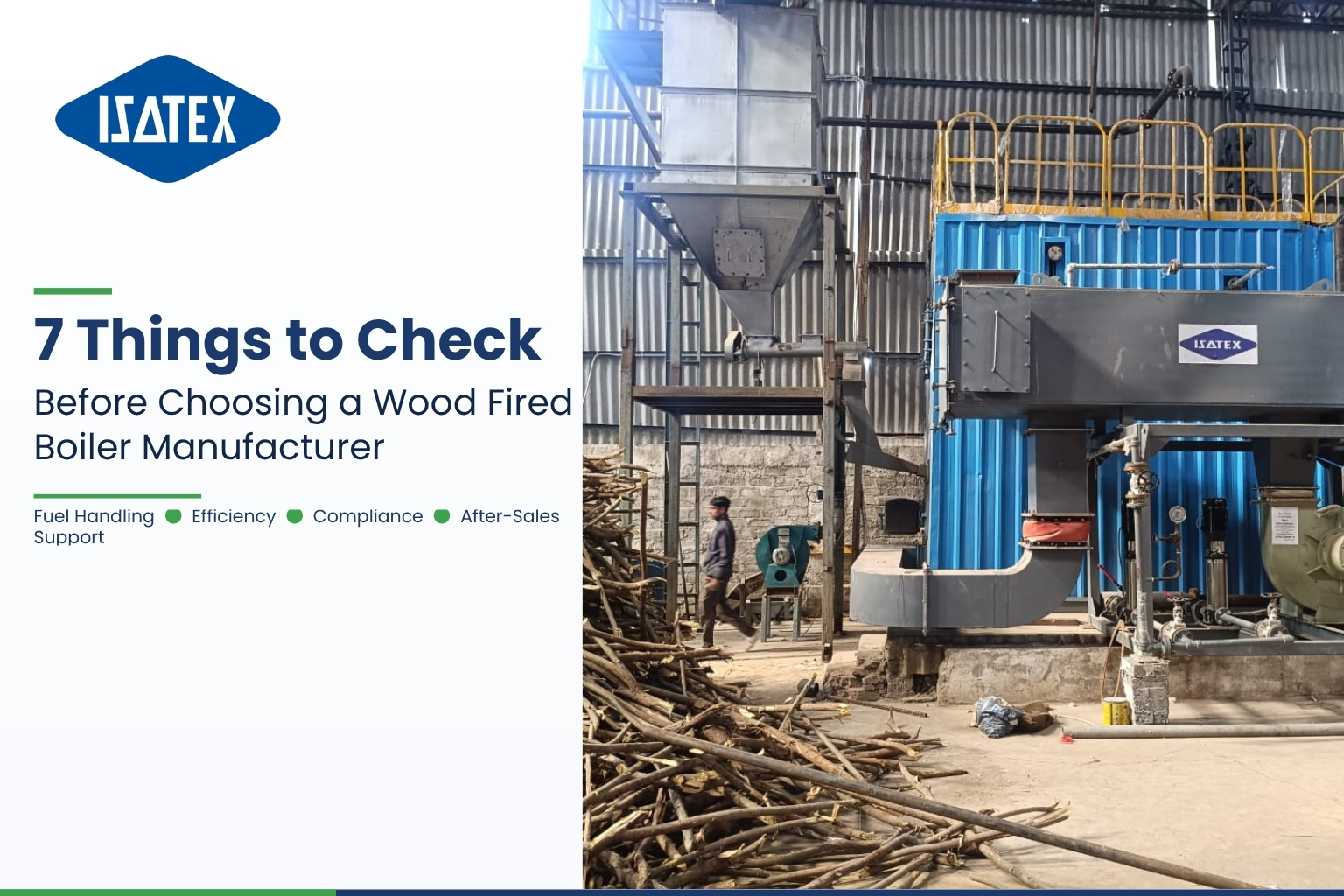
Wood is one of the most practical fuels for industrial steam in India. It is widely available, often cheaper than oil or gas, and a renewable source of energy. But wood is also a demanding fuel. Its moisture, size and quality change from one truckload to the next, and a boiler that is not designed for this variation will struggle to deliver steady steam.
That is why choosing between wood fired boiler manufacturers requires more care than comparing capacity and price. The boiler’s furnace design, fuel feeding system, heat recovery, emission control and after-sales support decide whether it delivers reliable steam for years or becomes a constant maintenance challenge.
Here are seven things plant heads, project engineers and purchase teams should check before selecting a wood fired steam boiler manufacturer.
Why Wood Fired Boilers Need Special Evaluation
Compared with oil or gas, wood has:
- Variable moisture content, which directly affects usable heat and combustion.
- Varying size and form: logs, chips, offcuts, sawdust and mixed biomass.
- Higher volatile matter, which needs adequate furnace volume and air distribution for complete combustion.
- Ash and particulate emissions, which need proper handling and control.
A boiler designed only for an ideal fuel sample will lose output and efficiency when real-world fuel arrives. A good manufacturer designs for the fuel you will actually burn.
1. Furnace Design Built for Wood
The furnace is where most wood fired boiler problems begin or are prevented.
Check:
- Furnace volume: wood needs enough space and residence time for volatiles to burn completely. An undersized furnace leads to smoke, unburnt fuel and lower efficiency.
- Grate type: fixed grates suit manual log firing; moving, reciprocating or travelling grates suit continuous feeding of chips and mixed biomass. The grate should match your fuel form and capacity.
- Air distribution: correct primary (under-grate) and secondary (over-fire) air for clean, complete combustion.
- Refractory quality: durable refractory and proper installation reduce maintenance and heat loss.
Ask: “Which fuel sizes and moisture levels was this furnace designed for, and how does output change when moisture increases?”
2. Fuel Flexibility and Feeding System
Few plants burn only one type of wood throughout the year. Seasonal availability and price often push plants to switch between logs, chips, sawdust and other biomass.
Check:
- Can the boiler handle multiple forms of wood and other biomass without major modification?
- Is the feeding manual, semi-automatic or fully automatic (screw feeders, hydraulic ram feeders, conveyors)?
- How is fuel storage and handling planned to keep fuel dry and flowing?
- What happens to steam output if fuel quality drops?
Automatic feeding improves steam consistency and reduces labour dependence, especially for larger capacities.
3. Realistic Efficiency Figures and Heat Recovery
Efficiency claims for wood fired boilers can vary widely between suppliers. The number itself matters less than the basis on which it is stated.
Check:
- Is efficiency stated on GCV or NCV basis? Figures on different bases cannot be compared directly.
- Which fuel and moisture level was assumed?
- At what load was the figure calculated?
- Which heat recovery equipment is included: economiser, air preheater?
- Will the manufacturer demonstrate performance at commissioning using a recognised test method ?
Ask every shortlisted supplier to state efficiency on the same basis, with the same fuel assumptions. Only then is the comparison fair.
4. Emission Control and Environmental Compliance
Wood combustion produces particulate emissions and ash. Emission norms and consent conditions set by the State Pollution Control Board apply to your installation.
Check:
- Which air pollution control equipment is included: multi-cyclone dust collector, bag filter, wet scrubber or electrostatic precipitator?
- Is the chimney height and design suitable for your capacity and consent conditions?
- Will the manufacturer support documentation for consent to establish and operate?
- How is fly ash and bottom ash collected and handled?
An emission control system that is undersized at the start is expensive to correct later.
5. Construction Quality and IBR Compliance
A wood fired steam boiler is a pressure vessel and must be designed, manufactured and registered in line with the Boilers Act, 2025 and applicable regulations.
Check:
- Are pressure parts built from certified materials with test certificates?
- Is welding done by certified welders with qualified procedures?
- Is stage-wise inspection and hydraulic testing done under the inspecting authority?
- Will the manufacturer provide complete documentation for registration at site?
- Can you visit the factory and see boilers under fabrication?
6. Ash Handling, Cleaning and Maintenance Access
Wood fired boilers need regular cleaning. Designs that make this difficult lead to skipped maintenance, falling efficiency and more downtime.
Check:
- How is bottom ash removed: manually or with automatic ash handling?
- Are tube cleaning and soot removal simple, with good access doors?
- Is there enough space around the boiler for maintenance?
- Which parts wear out most (grate bars, refractory, feeders), and how easy are they to replace?
- What is the recommended maintenance schedule?
7. After-Sales Service, Spares and References
Even a well-built boiler needs service support over 15–20 years of operation.
Check:
- Does the manufacturer have service engineers who can reach your site quickly?
- Are critical spares such as grate bars, refractory, feeder parts and controls readily available?
- Is operator training included at commissioning?
- Can you speak with or visit customers using similar wood fired boilers, ideally in your industry?
- How long has the manufacturer been building solid-fuel and biomass boilers?
Quick Comparison Table for Shortlisting
Evaluation Point | What Good Looks Like | Red Flag |
Furnace design | Sized for your actual fuel and moisture | “Works with any wood” without explanation |
Fuel feeding | Matched to fuel form and capacity | Manual feeding proposed for large continuous loads |
Efficiency | Clearly stated basis, fuel and load | Single headline figure with no basis |
Emission control | Sized for your capacity and consent needs | Offered as an optional extra with no sizing |
Construction | Certified materials, witnessed tests, full documents | Reluctance to share QAP or test records |
Maintenance | Easy access, clear schedule | Cramped layout, unclear wear-part list |
Service | Local engineers, spares stock, references | No references in similar applications |
Industry Applications for Wood Fired Steam Boilers
Wood fired steam boilers are widely used in industries with steady steam demand and access to wood or biomass, including:
- Food processing and edible oil
- Textile processing and dyeing
- Plywood and wood-based panels
- Paper and packaging
- Rubber processing
- Dairy
- Chemical and allied industries
- Agro-processing
Talk to Our Wood Fired Boiler Experts – Share your steam requirement, pressure and available wood types, and we will recommend the right configuration. View wood fired steam boilers.
Why Plants Choose ISOTEX Global
ISOTEX Global has 50 years of experience in industrial heating, with expertise across 100+ fuels and 10,000 installations. Our wood fired steam boilers are designed and manufactured in-house at our Ahmedabad and Dahej facilities, with statutory inspection, complete documentation and service support. As a wood fired steam boiler manufacturer in India serving domestic and export markets, we focus on designing for the fuel you will actually use.
Pre-Order Checklist
- Fuel type, size and moisture range shared with the manufacturer
- Furnace and grate design explained and matched to fuel
- Feeding system suited to capacity and labour availability
- Efficiency stated on a clear basis (GCV/NCV, fuel, load)
- Heat recovery equipment included and specified
- Emission control equipment sized for consent conditions
- Material certificates, welding and inspection plan confirmed
- Registration documentation included in scope
- Ash handling and maintenance access reviewed
- Service, spares and training commitments in writing
- Reference installation visited or verified.
Key Takeaways
- Wood is a variable fuel; the boiler must be designed for your real fuel, not an ideal sample.
- Furnace volume, grate type and air distribution decide combustion quality.
- Compare efficiency only on the same basis, fuel and load.
- Emission control and ash handling must be sized from the start.
- Construction quality, documentation and after-sales service determine long-term reliability.
Conclusion
The right choice among wood fired boiler manufacturers is the one that understands your fuel, designs the furnace and feeding system around it, states efficiency honestly, and supports you with compliance and service for years after commissioning.
Use the seven checks in this guide to compare suppliers on what really matters, not just the quotation.
Frequently Asked Questions
1. What should I look for in wood fired boiler manufacturers?
Check furnace design for wood, fuel feeding options, efficiency basis, emission control, construction quality and IBR compliance, maintenance access, and after-sales service with references.
2. Can a wood fired boiler burn other biomass fuels?
Many can, if the furnace, grate and feeding system are designed for them. Confirm the full list of fuels with the manufacturer before ordering.
3. How does wood moisture affect boiler performance?
Higher moisture means more heat is used to evaporate water, reducing usable heat, steam output and efficiency. Storing wood under cover and specifying the expected moisture range at design stage helps.
4. Is a wood fired steam boiler covered under IBR?
Steam boilers within the scope of the Boilers Act, 2025 must be manufactured, inspected and registered as per applicable regulations, regardless of fuel.
5. What emission control is needed for a wood fired boiler?
It depends on capacity and your State Pollution Control Board consent conditions. Common options include multi-cyclone dust collectors, bag filters, wet scrubbers and electrostatic precipitators.
6. Is manual or automatic feeding better?
Manual feeding can work for small boilers burning logs. Automatic feeding gives more consistent steam, better efficiency and lower labour dependence, especially at larger capacities.
7. How long does a wood fired steam boiler last?
With good design, proper water treatment and regular maintenance, a wood fired steam boiler can operate reliably for many years. Wear parts such as grate bars and refractory need periodic replacement.