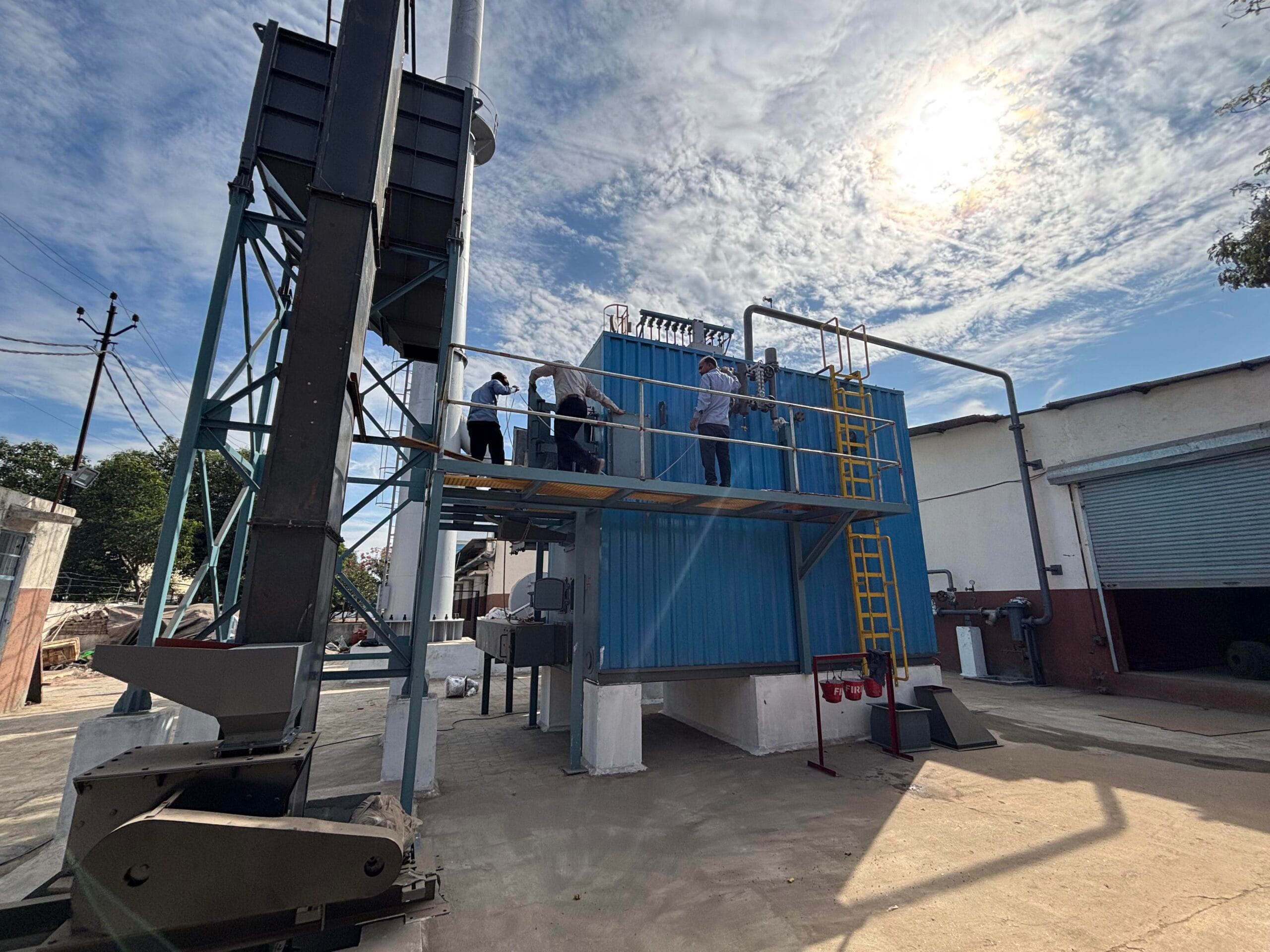
Choosing an industrial boiler is a 15 to 20 year decision, not a one-time purchase. The wrong capacity, fuel choice, or manufacturer can quietly drain lakhs of rupees every year in wasted fuel, unplanned downtime, and compliance headaches.
Whether you are commissioning a new plant or replacing an ageing boiler, the decision you make now will affect your fuel bills, your maintenance schedule, and your production uptime for the next two decades. That is why every factor below is broken down into a clear, practical checklist rather than a list of technical specifications.
This guide walks plant heads, purchase managers, and project engineers through exactly what to check before signing a purchase order — from real steam demand and fuel security to compliance and after-sales support.
What is an Industrial Boiler?
An industrial boiler is a closed vessel that heats water beyond its boiling point, using fuel to generate steam or hot water under pressure. That steam is then piped out to run turbines, dryers, sterilisers, reactors, or heating systems across the plant.
Unlike a domestic water heater, an industrial boiler typically runs continuously for years without a full shutdown, which is why build quality and combustion efficiency matter so much. Textiles, pharmaceuticals, food processing, chemicals, and paper industries all depend on boilers as their primary heat source.
Types of Industrial Boilers
Not every plant needs the same kind of boiler, and understanding the main types makes it easier to evaluate what a manufacturer is actually offering.
- Fire-tube boilers: Hot combustion gases pass through tubes submerged in water. Common in smaller plants because they are simple to operate and maintain.
- Water-tube boilers: Water flows through tubes surrounded by combustion gases, allowing higher pressures and faster steam generation. Preferred for larger, high-demand operations.
- Packaged boilers: Factory-assembled and shipped as a single unit, cutting on-site installation time considerably.
- Biomass-fired boilers: Run on agro-waste, wood, or biomass pellets, popular where fuel security and sustainability both matter.
- Coal, oil, and gas-fired boilers: Chosen based on regional fuel availability and cost, each with a different combustion profile and emissions footprint.
- Electric boilers: Used where a plant needs precise, flame-free heating, though running costs are typically higher.
The Problem: Most Boiler Buying Decisions Are Made on Price Alone
Many industrial buyers compare boiler quotations the way they would compare any commodity, where the lowest price wins. But a boiler is a 24×7 process asset. A cheaper unit with poor combustion efficiency, uncertified pressure parts, or a thin service network can cost far more over its lifetime than the difference in upfront price.
The Solution: Evaluate on Total Cost of Ownership, Not Sticker Price
The right approach is to evaluate every quotation against a fixed checklist covering capacity, fuel economics, compliance, automation, and after-sales support — not just the invoice value. Working with an established boiler manufacturing company in India that has a proven installation base gives buyers access to real performance data, instead of relying purely on brochure claims.
7 Factors to Check Before Choosing a Boiler Manufacturer
1. Actual Steam or Heat Demand — Not Just Rated Capacity
Get your process engineer to calculate real steam demand in kg/hr at peak load, not the nameplate capacity of your existing equipment. The best boiler manufacturers in India offer boilers across a wide capacity band, from 1 TPH to 40 TPH and beyond, so you can match capacity precisely instead of rounding up to the nearest standard size.
2. Fuel Type and Fuel Security
Your fuel choice should be driven by what is reliably available near your plant, not what is cheapest on paper this month. Options typically include wood, coal, biomass and agro-waste, gas, oil, and pellets.
3. Combustion and Thermal Efficiency
Ask for the combustion technology best suited to your selected fuel, and request tested thermal efficiency figures for that specific fuel — not generic efficiency ranges quoted for the boiler model in general, since actual efficiency varies with fuel moisture content and calorific value.
4. Compliance and Certification
Confirm the boiler manufacturer holds IBR approval, ASME certification, ISO certification, and CE marking where applicable. These determine whether your insurance is valid and whether your plant passes statutory inspection.
5. Automation Level
Look for automated fuel feeding and automated ash removal, along with combustion controls that modulate output based on real-time steam demand rather than manual operator adjustment.
6. Footprint, Installation Time, and Site Readiness
Factory-assembled, modular boiler designs can cut on-site installation time significantly compared to site-erected units, while reducing transportation and civil work costs.
7. After-Sales Network and Track Record
Check the boiler company’s installation base across countries served, number of installations, and industries covered, and confirm they offer AMC, O&M support, and revamping or retrofitting services.
Why this Matters: Real Numbers From the Field
As an illustrative example, on a well-engineered 4 TPH biomass-fired boiler operating around 7,000 hours a year, the efficiency gap between a standard design and a high-efficiency design can add up to fuel cost savings well above ₹20 lakh annually — often paying back the cost difference within 2 to 3 years. This is the kind of number that rarely shows up on a quotation, but shows up every single month on your fuel bill.
Common Mistakes When Choosing an Industrial Boiler
Even experienced buyers fall into a handful of avoidable traps when finalising a boiler purchase:
- Sizing to existing equipment instead of actual demand. Carrying over the old boiler’s rated capacity without recalculating real peak steam demand almost always leads to an oversized, inefficient unit.
- Ignoring fuel availability five years out. A fuel that is cheap and abundant today may not stay that way, and switching fuel types after installation is expensive.
- Treating certification as a formality. Skipping a close look at IBR, ASME, or ISO documentation can invalidate insurance or cause a plant to fail a statutory inspection later.
- Underweighting after-sales support. A low-cost boiler from a manufacturer with a thin service network can mean weeks of downtime when a part fails.
- Comparing quotations line by line instead of lifecycle cost. Two similarly priced boilers can differ by lakhs of rupees a year once fuel efficiency and maintenance are factored in.
Industries that Depend on Getting This Decision Right
Chemical, pharmaceutical, textile, food and beverages, edible oil, paper, dairy, printing and packaging, and plywood and woodworking industries all run continuous, process-critical heating loads where boiler reliability directly affects production output.
Why Choose Isotex Global for Industrial Boiler Solutions?
Choosing the right checklist is only half the job. The other half is choosing a boiler company in India who can actually deliver against it. Here is a closer look at how Isotex Global helps plants make this decision with confidence.
50 Years of Engineering Industrial Thermal Solutions
Isotex Global (Isotex Corporation Pvt. Ltd.) has been engineering industrial thermal solutions for over 50 years, with manufacturing facilities in Ahmedabad and Dahej, Gujarat. As a certified boiler manufacturing company in India — IBR approved, and ASME, ISO, and CE certified — Isotex has delivered installations across 75+ countries and 13+ industry sectors.
Boilers Engineered Around Your Fuel and Steam Demand
Isotex Global designs and manufactures industrial boilers and thermal solutions across a wide capacity range, built for fuels ranging from biomass and agro-waste to coal, gas, and oil. As one of the best boiler manufacturers in India, every unit is engineered in-house, from combustion design to automation, so the boiler that reaches your plant is matched to your actual steam demand rather than the nearest standard size on a catalogue.
How We Help You Choose the Right Solution
Isotex Global’s engineering team works directly with plant heads and purchase managers to map fuel availability, steam demand, and compliance requirements before recommending a configuration, following the same seven-point evaluation covered in this guide. With over five decades of installation data behind them, the team can share real performance benchmarks from comparable plants, not just projected figures.
Conclusion
The right industrial boiler is the one engineered to your actual steam demand, your available fuel, your compliance requirements, and your plant’s long-term operating economics — not the one with the lowest number on the quotation. Partnering with an established boiler company in India gives you access to that engineering depth from day one.
Ready to Evaluate Your Boiler Requirement?
Share your capacity requirement and fuel preference with the Isotex Global engineering team — they respond within 24 hours with a solution engineered for your plant.
Get a Quote: https://isotexglobal.com/contact-us/
Frequently Asked Questions
Q1. Who are the leading boiler manufacturers in India?
India has several established boiler manufacturers. Buyers should shortlist based on certifications such as IBR, ASME, CE, and ISO, installation track record, fuel flexibility, and after-sales service network, rather than brand recognition alone.
Q2. What capacity boiler does my plant need?
Capacity is calculated from your actual steam or heat demand, not from your existing boiler’s rated size. A qualified boiler manufacturing company will size this based on your process data and peak load calculations.
Q3. Which fuel type is most cost-effective for an industrial boiler?
It depends on local fuel availability. Biomass and agro-waste fuels are typically the most economical where available; gas and oil offer greater automation and cleaner combustion; coal remains cost-effective for high-capacity continuous operations.
Q4. How long does it take to install a new industrial boiler?
Factory-assembled, modular boiler designs significantly reduce on-site installation time compared to site-erected boilers, often cutting commissioning time considerably.
Q5. What certifications should an industrial boiler company have?
At minimum, look for IBR approval and ISO certification. For export-oriented or multinational operations, ASME ‘S’ Stamp and CE marking are also important benchmarks of quality and safety.